2017 ARSC Award for Excellence in Best Historical Research in Record Labels, Best Discography

The Gramophone Company’s First Indian Recordings, 1899 to 1907
By: Michael Kinnear
Revised, Corrected and Expanded Edition with a Lacuna of the first known disc recordings of Tibetan performers
USD $48.00 Plus Postage, USD $32.00


First Published 1994 as: The Gramophone Company’s First Indian Recordings 1899-1907. Revised, Corrected and Expanded Edition with a Lacuna of the first known disc recordings of Tibetan performers.
The Gramophone Company’s First Indian Recordings 1899 to 1907, is a discographical study of Indian recordings taken in London in 1899 for E. Berliner’s Gramophone, and at various places in India between 1902 and 1907, detailing all the known or traced recordings of several dialects and musical styles together with a study of the history and development of the sound recording industry in India. This newly revised study contains numerous additions and corrections, in particular, to the variety of alternate pressings made of these recordings. With an appendix and indices. With illustrations in the text.
‘Preface to the new edition’
When this work was originally published, my friend and confidant in all matters concerning discography, the Late Frank Andrews had advised me that the registers from which a bulk of the information had been gleaned from numerical registers originally maintained by the Hanover factory where the records were pressed.
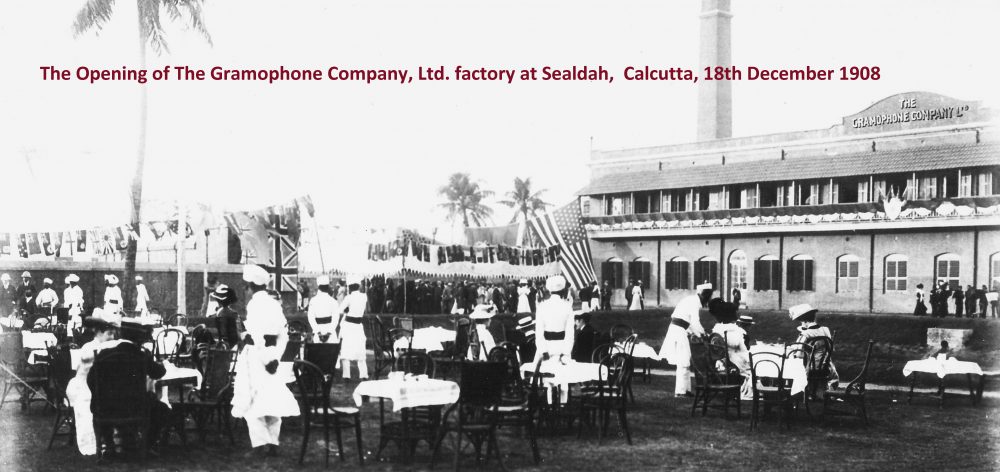
Sometime later I discovered registers at the Dum Dum factory that gave a different perspective on which recordings were re-pressed at Sealdah, Calcutta. These hand written numerical registers were difficult to read and interpret. However, when assembled, the information revealed that there were more reissued and repressed recordings made at Calcutta, than had been originally documented in the earlier edition.
All this information and some other detail has been added to this edition, along with a series of Tibetan recordings that had not previously been documented, about the 1905 recording sessions, along with some extra information in regard to the 1906-1907 recording sessions.
Michael Kinnear [2016]
‘History’
This project has been in a state of continuous progress for about twenty‑five years, starting with initial enquiries and research in the. mid 1960’s into the history and development of the sound recording industry in India. My interest in record collecting, in general, had made me aware of such label names as “HIS MASTER’S VOICE”, “COLUMBIA”, “PATHE” and many other European record labels. My early requests for information about the evolution of the sound recording industry in India were usually rebuffed by such comments as “records were first made in India at Dum Dum in the 1930’s”; “nowadays and since long, there is only the HMV Company”; “all other companies have gone out (ceased) now from India”.
However, as I had read “Music on Record” ‑ the autobiography of F.W. Gaisberg (the first recording engineer of The Gramophone Company) originally published in 1947, I realized there must have been another side to the history of sound recording in India. In Gaisberg’s autobiography, he describes in Chapter four under the title of “The Gramophone Goes East” (1902), how he made the first disc records for the gramophone, of Indian artists in 1902. With little more than that information during my first visit to India in 1969, I endeavored to collect some early recordings, and indeed, found many worn out single side recorded discs of Miss Gauhar Jan and other Indian vocalists.
During several visits to India over the next few years, I collected several hundred old records, without really knowing how these individual pieces fitted into the history of recorded music in India. My guidelines for a better understanding of the sound recording industry, in general, were the splendid articles by such record researchers as Peter Adamson, late Frank Andrews, late Ernie Bayly, the late James Dennis, Alan Kelly and late Brian Rust, whose published works have appeared in the specialized journals for record collectors such as “The Record Collector”, “The Hillandale News” and “The Talking Machine Review‑International”.
The knowledge and co‑operation of these dedicated researchers, along with their personal friendship, has both encouraged and inspired me in the enjoyment of my own research. My first debt of gratitude is due to these eminent researchers for laying the stones of my pathway.
While a large amount of the historical perspective and discographical information has been in my possession for many years, it has only been possible to sort through the mass of research materials and bring this project into a tangible form, through the assistance and cooperation of numerous people, institutes and libraries, many of whom have watched this project grow from its humble beginnings to completion.
[Michael Kinnear]

SAMPLE PAGES


Product Details
♦ Published Independently: Bajakhana – Michael Kinnear, Second Edition, 2016.
♦ Language: English
♦ Digital Download PDF Book: 28 + 374 pages
♦ ISBN-10: 0-9577355-6-1
♦ ISBN-13: 978-0-9577355-6-9

Book Price: USD $48.00
Postage: Intl. Standard Post USD $32.00
1 kg. Standard Post, Internet Tracking,
Signature on Delivery
Total at Checkout = USD $80.00
